Keywords Aren’t Dead, But the Way You Use Them Should Be Different
If you’ve heard anyone say “keywords are dead,” they’re half right and half dangerously wrong.
What’s dead is the old playbook: forcing awkward exact-match phrases into sentences, stuffing the same term into every other paragraph, and spinning up dozens of near-identical pages hoping to game the algorithm. That approach stopped working years ago, and in 2026, it’ll actively hurt you.
What’s very much alive and more important than ever is understanding the language your audience actually uses. AI-powered search has raised the bar, not eliminated the game.
The Old Playbook Is Retired. Here’s What Got Cut.
Exact-match phrase forcing. Nobody naturally writes “best Pest Control Service Wall Township NJ” in a sentence. When you contort your copy to fit a keyword verbatim, readers notice. Search engines notice too.
Keyword stuffing. Repeating a term ten times on a page doesn’t signal relevance anymore; it signals spam. Modern algorithms are sophisticated enough to read for meaning, not just word frequency.
Thin variation pages. Creating separate pages for “digital marketing agency NJ,” “NJ digital marketing agency,” and “digital marketing New Jersey agency” used to be a common tactic. Today, it fragments your authority and dilutes your rankings instead of multiplying them.
Meta keywords tags. These HTML relics from the early internet are ignored by every major search engine. If you’re still filling them in, you’re spending time on something that has zero impact.
What Search Actually Rewards Today
Topic Clusters Over Isolated Terms
Think of your content strategy less like a keyword list and more like a web of interconnected ideas. A strong pillar page on, say, “local SEO for New Jersey businesses,” surrounded by supporting articles on reviews, citations, and Google Business profiles, that’s what builds lasting authority. Search engines reward depth and coherence, not breadth of keyword coverage.
Semantic Search: Context Is Everything
When someone types a query, Google isn’t just matching words; it’s trying to understand what they mean. That shift to semantic search means your content needs to cover a topic thoroughly and conversationally, the way a knowledgeable person would explain it. Natural language around a subject matters more than hitting a specific phrase.
Search Intent: The Question Behind the Question
Every search has a “why” behind it. Someone asking “what is technical SEO” wants an explanation. Someone asking “technical SEO agency near me” wants to hire someone. Someone typing “Moz vs. Semrush” is comparing options before making a decision. Matching your content to that intent, informational, navigational, or transactional, is one of the most powerful moves in modern SEO, and most businesses get it wrong.
AI Search Is Now Part of the Equation
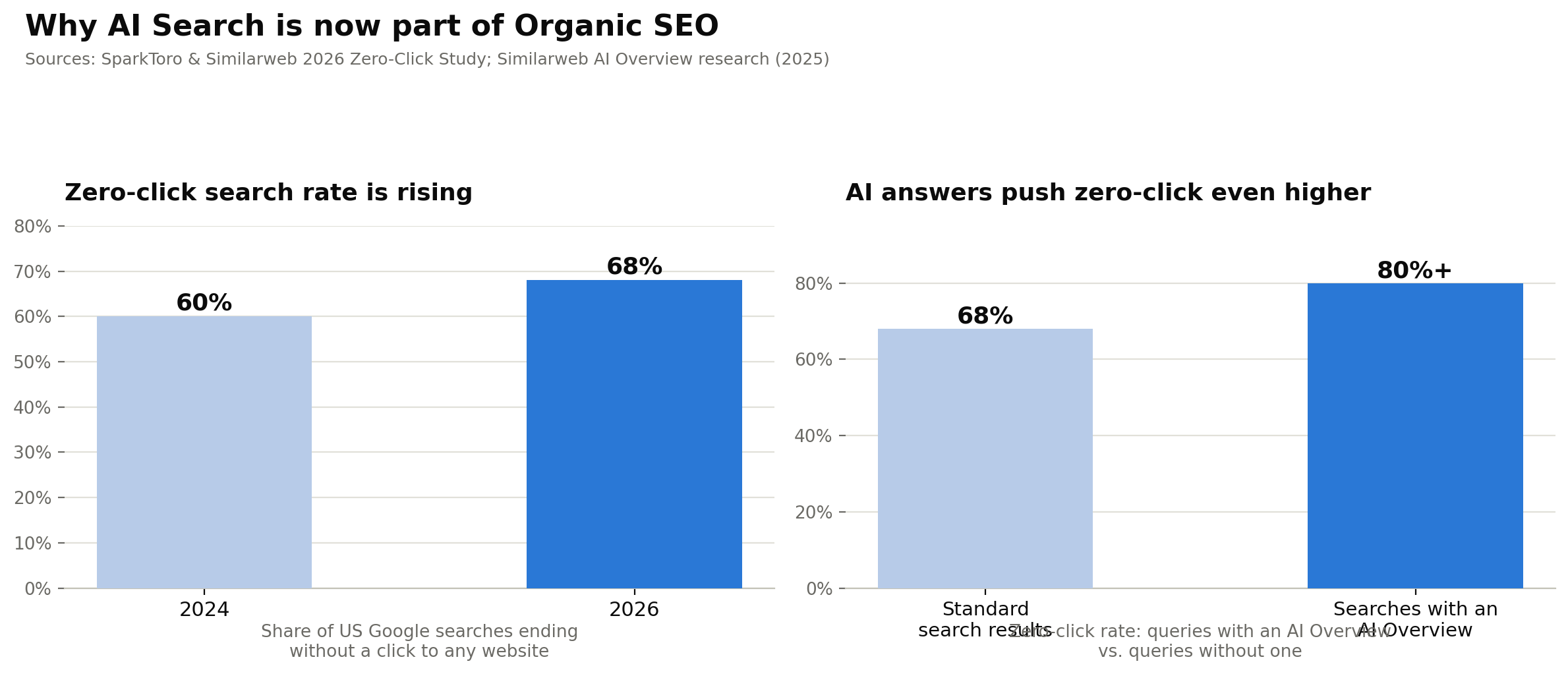
Here’s something most businesses aren’t thinking about yet: AI tools like ChatGPT, Gemini, and Perplexity are pulling answers from high-ranking, well-structured content across the web. If your site has authoritative, keyword-informed content, you’re not just showing up in Google; you’re getting surfaced in AI-generated answers, too. The brands that will dominate the next wave of search are the ones building content worth citing.
So What Should You Actually Do?
Stop thinking of keywords as targets to hit and start thinking of them as signals pointing you toward your audience’s real questions.
Your job is to answer those questions better than anyone else with firsthand expertise, genuine depth, and a clear point of view. One comprehensive, well-structured article built around a topic cluster will outperform ten thin pages chasing individual keywords every time.
Build content that establishes topical authority. Show search engines (and your readers) that you actually know your subject. Cover it from multiple angles. Link your ideas together. Keep it current.
Not Sure Where to Start?
Every business is in a different place with this. The right strategy for a national e-commerce brand looks very different from the right strategy for a local service business in Monmouth County.
At Shoreline Digital Marketing, we start by understanding your goals, your audience, and the competitive landscape before we recommend anything. Whether you’re focused on organic search, paid advertising, or building presence in AI-driven results, the approach matters.
Get in touch with our team and let’s talk about where your strategy stands today.