An example of how Shoreline Digital Agency is helping businesses prepare for AI-powered discovery through innovative SEO and proprietary on-page optimization methods.
Search engine optimization has traditionally focused on helping businesses appear when potential customers search Google for products, services, and information. Today, customers have additional ways to discover and evaluate businesses, including conversational AI platforms like ChatGPT.
For our client, a New Jersey construction company, that shift recently became a real-world business opportunity.
According to information shared with Shoreline, a prospective customer initially discovered our client’s business through ChatGPT. The customer then continued using the AI platform to research and compare the business with other competitors in the area before ultimately contacting the company and becoming a customer.
This instance offers an encouraging example of how AI Search is contributing to our broader customer acquisition strategy. It also highlights the importance of Shoreline’s evolving approach to AI Search optimization, which combines established SEO practices with proprietary methods designed to improve how businesses are represented and discovered through AI-powered platforms.
While a single customer interaction cannot establish a conversion rate or prove that any individual optimization caused a recommendation, it demonstrates something increasingly relevant to businesses: AI-powered search can play a meaningful role in how customers find, evaluate, and select service providers.
The Result: A Customer Journey That Began With ChatGPT
The most significant outcome of this case study is straightforward: Our client gained a customer whose initial discovery of the business was through ChatGPT.
The customer did not simply encounter the company’s name in an AI-generated answer and immediately make contact. Instead, ChatGPT reportedly remained part of the decision-making process as the customer compared their company against other businesses in the same field.
The reported journey unfolded in four stages:
- Initial discovery: The prospective customer encountered the company while using ChatGPT.
- Research and comparison: The customer continued using ChatGPT to evaluate and compare the company alongside other businesses.
- Direct contact: After conducting this research, the customer contacted the company.
- Customer acquisition: The interaction ultimately resulted in the customer doing business with the company.
This is a valuable distinction because it illustrates two separate ways AI Search may influence customer acquisition.
First, AI-powered platforms can introduce businesses to potential customers who may not have previously known about them.
Second, these platforms can remain part of the research process as customers compare providers, evaluate qualifications, and decide which business to contact.
For companies investing in online visibility, being discoverable during both stages represents an emerging marketing opportunity. It also encourages a hypothesis that has been circling the digital marketing space for years now; AI Optimization can translate to leads.
The customer’s account provides evidence of one successful journey, although it does not establish which sources ChatGPT used, how the platform evaluated the businesses, or whether Shoreline’s optimizations directly influenced the recommendation.
The Challenge: Helping Contractors Get Discovered Beyond Traditional Google Search
Construction is a competitive industry, particularly when customers are evaluating companies for substantial projects.
Prospective customers may research a contractor’s services, experience, service areas, reputation, and qualifications before making an inquiry. These decisions can involve multiple searches, website visits, reviews, and comparisons.
Traditionally, much of that research has taken place through search engines and business directories.
AI-powered platforms introduce another discovery experience. Instead of searching for individual keywords and reviewing a list of results, customers can ask conversational questions such as:
- Which construction companies serve South Jersey?
- What should I look for when choosing a commercial construction contractor?
- How do I compare construction companies for a renovation project?
- What questions should I ask before hiring a general contractor?
- Which contractors have experience with the type of project I’m planning?
AI systems may respond by summarizing information, suggesting considerations, identifying relevant businesses, or directing users toward additional sources.
For construction companies, this creates a challenge: maintaining strong traditional search visibility while ensuring their online information clearly communicates the services, experience, and expertise that potential customers are researching.
We do not believe that this avenue is an all-encompassing redefinition of what digital marketing is in the AI world of today. Instead, we see it as an additional opportunity to create meaningful visibility in crowded markets.
Why AI Search Visibility Matters for Construction Companies
Construction projects often involve extensive consideration before a customer makes contact.
A homeowner or commercial property owner may want to understand the scope of a project, compare potential approaches, and evaluate multiple contractors before requesting an estimate.
AI tools can become part of that process because they allow users to ask follow-up questions and explore different considerations within the same conversation.
This means a business’s online presence needs to support more than a single search query.
Its website should provide accurate, useful information about its capabilities, services, relevant experience, and geographic coverage.
For this client, Shoreline’s broader SEO and content efforts have focused on improving the clarity and usefulness of the company’s online presence, including service-related and location-specific content.
These efforts provide a foundation for traditional organic search while supporting Shoreline’s broader work to improve discoverability across AI-powered search experiences.
Shoreline’s Approach: Combining Traditional SEO With Proprietary AI Visibility Optimization
Shoreline Digital Agency is developing and refining proprietary methods for increasing AI visibility through on-page optimization.
These methods build on established Organic SEO practices while placing additional emphasis on how website content is organized, how business expertise is communicated, and how information may be retrieved and interpreted by AI-powered search systems.
Our approach is informed by the understanding that customers increasingly ask detailed, conversational questions rather than relying exclusively on short keyword searches.
A website that clearly answers those questions can provide a more useful experience for potential customers while making its information easier for search systems to discover.
Shoreline’s AI-focused content methodology incorporates several key elements.
1. Creating Clear, Detailed Service Content
Service pages are an essential part of a contractor’s online presence.
They explain what a company offers, which customers it serves, and how potential clients can move forward with a project.
Shoreline’s content strategy emphasizes informative service descriptions that address the questions customers may have before contacting a business.
For construction companies, useful service content can explain:
- The types of construction or renovation projects the company handles.
- What customers should understand about the project process.
- Relevant considerations during planning and preparation.
- The company’s actual service areas.
- How customers can request additional information or discuss a project.
This approach supports traditional service-related keyword targeting while providing context that may also be useful in AI-powered discovery.
The objective is to communicate a company’s capabilities accurately and thoroughly rather than relying on generic marketing language.
2. Structuring Pages for Clarity and Accessibility
Page structure influences how easily visitors can find and understand information.
Shoreline’s proprietary on-page AI visibility methods place particular emphasis on organizing content around distinct topics, relevant headings, and clear explanations.
For example, a construction service page may benefit from separating information about project types, planning considerations, service areas, and frequently asked questions into logical sections.
This makes the page more useful for readers and provides clearer context for search systems processing its content.
Effective structure can include:
- Descriptive H1, H2, and H3 headings.
- Direct explanations of important services and concepts.
- Relevant supporting details.
- Logical internal links between related pages.
- Clear distinctions between different services and geographic markets.
- Helpful answers to common customer questions.
These improvements are designed to strengthen content accessibility and relevance. They do not guarantee that an AI platform will cite or recommend a particular page.
3. Addressing Questions Customers Ask AI Platforms
One important difference between traditional keyword searches and conversational AI research is the level of detail customers can include in their questions.
Someone searching Google might enter “commercial construction company NJ.”
A customer using ChatGPT might ask, “What should I look for when comparing commercial construction companies in New Jersey, and what questions should I ask before choosing one?”
Both searches relate to construction services, but the second involves a more detailed research process.
Shoreline’s AI-focused content strategy accounts for these conversational information needs by developing useful explanations and especially FAQ content.
For a construction company like our client here, and other service businesses, relevant questions may concern project planning, contractor qualifications, timelines, construction methods, or geographic availability.
By addressing these topics accurately, businesses can create resources that support customer education while strengthening the depth and usefulness of their websites.
4. Building Relevant Service and Location Content
Geographic relevance remains important for businesses serving defined markets.
A contractor’s website should accurately communicate where the company operates and which services are available in those areas.
Shoreline’s broader SEO work for this client has included location-focused content intended to help prospective customers find relevant information about the company’s geographic coverage.
Location pages are most valuable when they offer meaningful information rather than repeating the same content with different city names.
A useful location page may connect a particular community with the company’s relevant services, actual experience, and contact options.
This helps visitors understand whether the business is appropriate for their needs.
It can also strengthen the contextual information available about the company’s service area across traditional and AI-powered search experiences.
5. Connecting Related Information Through Internal Links
Internal linking helps website visitors navigate between related services, locations, and educational resources.
For example, a customer researching a construction company’s service area may benefit from a direct link to the relevant service page or contact information.
Shoreline incorporates contextual internal linking into its content strategy to help visitors move through the website and discover information related to their needs.
A logical internal linking structure can also support search engine crawling and help clarify relationships between pages.
This is one of several established SEO practices that remain valuable as businesses adapt to AI-powered discovery.
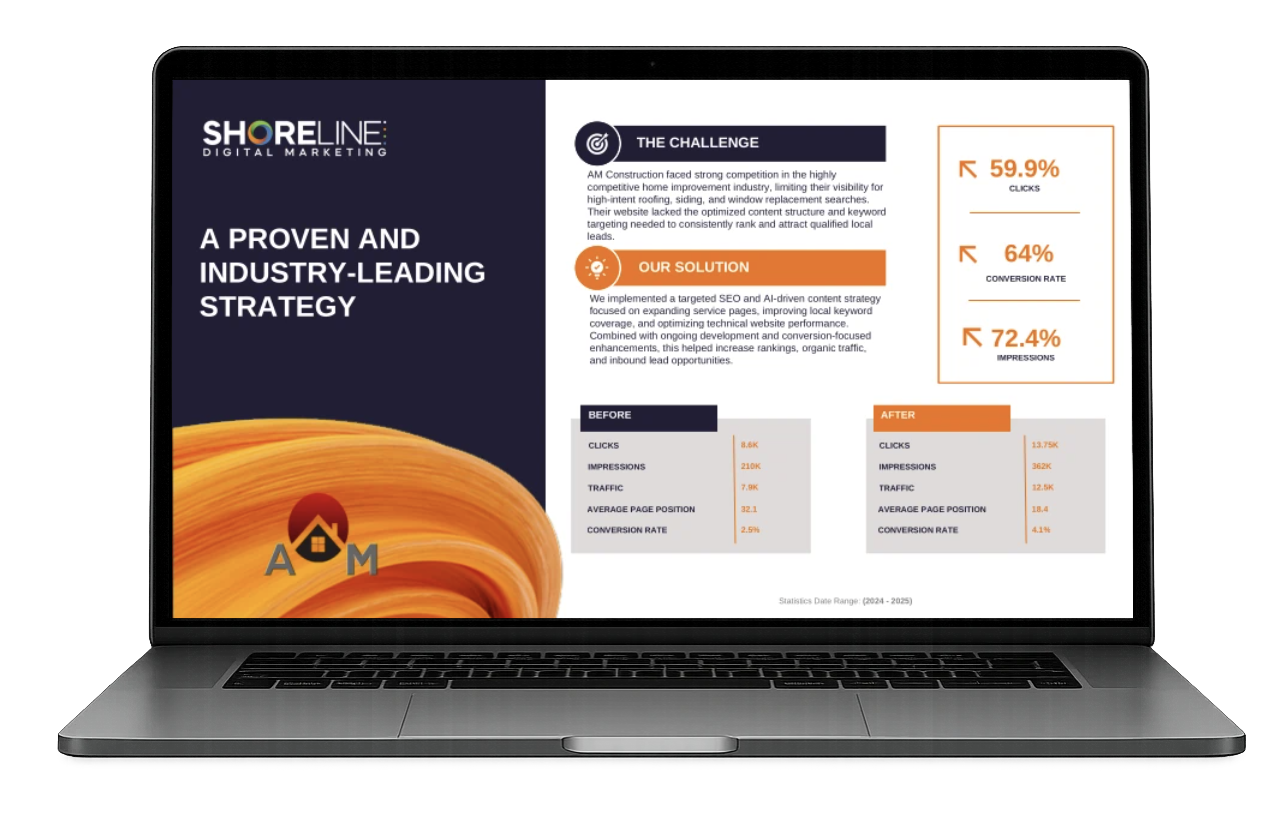
View The SEO Case Study HERE
What Makes Shoreline’s AI SEO Approach Different?
The emergence of AI Search has created new questions about how businesses should structure and present their online information.
Shoreline’s response has been to build on established SEO fundamentals while developing proprietary on-page methods specifically intended to support AI visibility.
These methods focus on the clarity, relevance, organization, and accessibility of business information.
Rather than treating AI Search as a replacement for traditional SEO, Shoreline approaches it as an additional consideration within a broader digital marketing strategy.
Our ongoing work involves:
- Evaluating how businesses are represented across AI-powered search experiences.
- Developing hypotheses about content characteristics that may support discoverability.
- Applying targeted on-page content and structural improvements.
- Monitoring available AI visibility data and reported customer interactions.
- Refining our approach as platforms, search behavior, and measurement capabilities evolve.
Because AI platforms do not fully disclose every factor involved in generating business recommendations, no agency can reliably promise that a specific optimization will produce inclusion in a particular response.
Shoreline’s methodology is therefore built around continuous improvement, practical experimentation, and responsible performance evaluation.
For businesses interested in these opportunities, our AI Search optimization services complement traditional SEO, content development, and website optimization.
What this Lead Tells Us About AI Search and Customer Acquisition
This particular client experience is particularly interesting because ChatGPT reportedly influenced more than initial discovery.
The customer continued using the platform to compare businesses before ultimately selecting this specific construction company.
This illustrates how AI-powered search may participate in multiple stages of the buying journey.
AI Search Can Introduce Customers to Businesses
A business recommendation or mention within an AI-generated response may expose a company to someone who has not previously encountered its website, advertisements, or traditional search listings.
For businesses competing in crowded markets, this represents another potential source of discovery.
AI Can Support Customer Research and Comparison
Customers can use AI platforms to ask follow-up questions, compare providers, and explore relevant considerations before making a decision.
A business’s website and broader online presence should therefore communicate accurate information that helps customers understand its services and qualifications.
However, the construction account does not establish exactly what ChatGPT presented during the comparison process.
AI-Sourced Discovery Can Lead to Business Outcomes
The reported client interaction ultimately resulted in a customer relationship.
This is an encouraging example because it connects an AI-assisted discovery experience with an actual business outcome.
At the same time, it represents one reported customer journey. It does not yet establish an AI Search conversion rate, prove the effectiveness of an individual optimization, or predict how frequently similar outcomes will occur.
The value of the example lies in demonstrating that AI-powered discovery can be part of a real customer acquisition process.
Measuring AI Visibility Beyond Rankings and Website Traffic
Traditional SEO reporting often focuses on keyword rankings, organic impressions, website traffic, and conversions.
Those metrics remain important, but they do not fully describe how businesses may appear within AI-generated answers.
AI Search measurement introduces additional considerations.
Businesses may want to understand:
- Whether their company is mentioned in responses to relevant customer questions.
- Whether AI platforms cite their website.
- How their visibility compares with relevant competitors.
- Whether business information presented by AI tools is accurate.
- How visibility changes across different platforms or reporting periods.
- Whether customers report discovering the business through AI-powered tools.
Specialized platforms can provide sampled AI visibility measurements, but those measurements do not represent every possible customer prompt or recommendation.
Similarly, website analytics may not capture every interaction that begins inside an AI platform.
A customer might discover a business through ChatGPT, conduct additional research, and later contact the company directly.
Without customer feedback or appropriate attribution data, that journey may not be fully reflected in standard traffic reports.
This client’s experience demonstrates why direct customer-reported information can be valuable alongside traditional marketing analytics.
For businesses looking to better understand these developing metrics, Shoreline’s AI Search services address the growing importance of visibility across AI-powered discovery channels.
Why AI Search Optimization Should Complement Traditional SEO
AI-powered discovery is changing how some customers research businesses, but traditional search engines remain an important part of the customer journey.
Businesses still benefit from technically accessible websites, accurate service information, relevant local content, and strong user experiences.
These fundamentals support organic search performance while providing a useful foundation for broader online discovery.
Shoreline’s approach is to strengthen those established practices while adapting content strategy to account for conversational searches and AI-generated answers.
For contractors and other service businesses, that means developing websites that clearly explain their capabilities, answer customer questions, and provide useful paths toward contacting the company.
This AI instance is a great example of why this work matters.
A customer reportedly discovered the business through ChatGPT, continued evaluating available options, and ultimately became a customer.
Although the interaction cannot be attributed to one specific optimization, it demonstrates the type of customer journey that Shoreline’s evolving AI Search strategy is intended to support.
The Takeaway: AI Search Visibility Is Becoming Part of the Customer Journey
This construction company’s case study highlights an emerging opportunity for businesses investing in digital marketing.
AI-powered platforms can play a role in how customers discover companies, compare service providers, and make purchasing decisions.
For this client, that process reportedly led from an initial ChatGPT discovery to a new customer.
For Shoreline Digital Agency, the experience provides a real-world example of why we continue developing proprietary on-page AI visibility optimization methods alongside traditional SEO strategies.
Our objective is to help businesses maintain strong foundations for organic search while improving the clarity, relevance, and accessibility of their information for AI-powered discovery.
As AI Search evolves, we will continue testing, measuring, and refining these methods to better understand how businesses can strengthen their visibility across an expanding range of search experiences.
Prepare Your Business for AI-Powered Search With Shoreline Digital Agency
Customers are increasingly able to use AI platforms to research services, compare businesses, and explore purchasing decisions.
Your company’s website should provide the accurate, useful information needed to support those interactions while continuing to perform for traditional search.
Shoreline Digital Agency combines established SEO expertise with evolving, proprietary on-page AI visibility optimization methods designed to help businesses adapt to these changes.
Want to understand how your business can improve its visibility across traditional and AI-powered search?
Explore Shoreline’s AI Search optimization services or contact Shoreline Digital Agency to discuss your website, search visibility, and opportunities for growth.
Frequently Asked Questions
Can ChatGPT generate leads for local businesses?
Yes. Customers can use ChatGPT to discover businesses, research services, and compare potential providers before making contact. This client’s experience is one reported example of a customer who initially discovered a business through ChatGPT and ultimately hired it. However, results vary, and appearing in AI-generated answers does not guarantee leads or sales.
How can I get my business recommended by ChatGPT?
There is no guaranteed method for getting a business recommended by ChatGPT. Businesses can improve the quality and accessibility of their online information through detailed service pages, accurate business listings, useful educational content, and relevant third-party references. These practices may support AI-powered discovery, but individual recommendations depend on factors outside a business’s control.
What is the difference between SEO and AI Search optimization?
Traditional SEO focuses on improving a website’s visibility and performance in search engines. AI Search optimization considers how business information may be discovered, interpreted, cited, or included in AI-generated responses. The approaches overlap significantly, and strong technical SEO, relevant content, and clear website organization remain valuable foundations for both.
Does AI Search optimization work for construction companies and contractors?
AI Search optimization can be relevant for construction companies and contractors because prospective customers may use AI tools to research projects, compare providers, and evaluate service options. Clear service information, accurate geographic coverage, useful project-related content, and credible evidence of expertise can help support online discovery. However, specific results cannot be guaranteed.
How do you measure AI Search visibility and lead generation?
AI Search visibility can be evaluated through sampled brand mentions, website citations, competitor comparisons, and platform-specific monitoring tools. Lead generation may also be assessed through website analytics, CRM data, customer inquiries, and direct customer-reported attribution. No single measurement method captures every AI-assisted customer interaction, so businesses should interpret these signals together.