Every few years, someone declares SEO dead.
Maybe you’ve seen the headlines.
“AI is replacing Google.”
“Nobody clicks websites anymore.”
“ChatGPT killed SEO.”
“Search is over.”
If you’ve owned a business for any length of time, you’ve probably heard some version of these predictions before. The funny thing is, people have been saying SEO is dead for nearly twenty years. And guess what? It’s still here, and maybe bigger than ever.
Every single day, billions of searches still happen. Businesses still compete for visibility. Customers still look for products, services, recommendations, and answers online.
The difference isn’t that SEO has disappeared. The difference is that SEO has matured. It’s changing, just like it always is. The businesses that understand this are gaining an enormous advantage. The ones chasing shortcuts are being left behind.
Remember When Websites Didn’t Matter?
Think back to the early days of the internet. Simply having a website made your business look modern. It didn’t need to be particularly good. It just needed to exist.
Then websites became expected. The businesses with better websites began winning. SEO has followed a similar path.
Years ago, you could rank a page by repeating the same keyword dozens of times. Backlinks could be purchased by the thousands. Thin content often ranked surprisingly well.
And for better or for worse, those days are gone. Google has become much better at recognizing genuinely helpful content. In most ways that’s a good thing because it means that businesses that invest in their customers are finally being rewarded.
Search Has Always Changed
One mistake many people make is assuming today’s changes are unprecedented.
They’re not.
Over the years we’ve seen:
- Mobile-first indexing
- Local search
- Voice search
- Featured snippets
- Core Web Vitals
- Helpful Content Updates
- Entity-based search
- AI Overviews
Every one of those changes caused people to predict the end of SEO. Instead, SEO adapted. It isn’t the first time and it will not be the last.
AI Didn’t Kill SEO
AI did not kill SEO. It isn’t going to. It simply raised the bar.
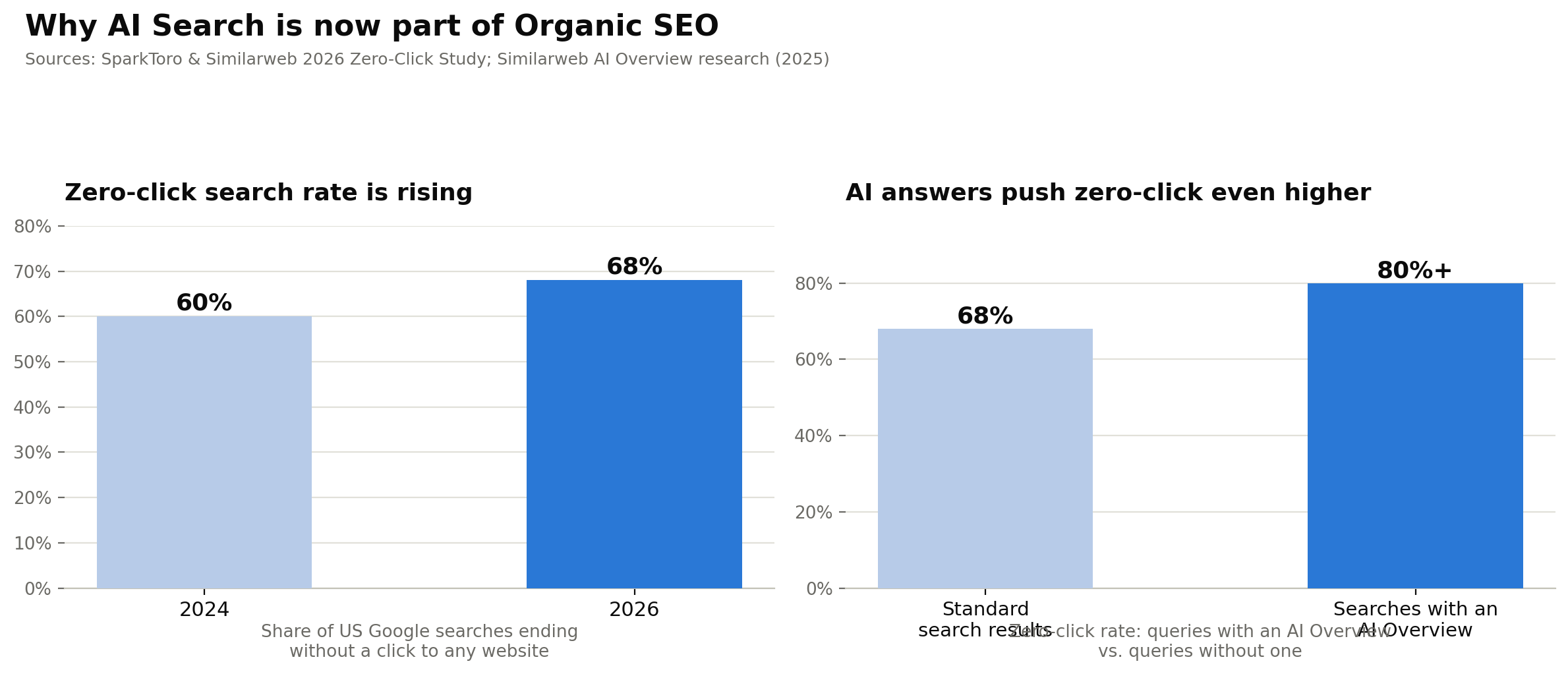
Artificial intelligence has absolutely changed search. Google now summarizes answers. ChatGPT recommends businesses. Gemini explains complex topics. Claude answers detailed questions.
But here’s something many people overlook. Every one of those systems still needs information.
LLMs like this do not just invent expertise. As much as people market AI as “Thinking Machines” they need to study their answers from somewhere before giving their spark notes version to you. They discover information. But from where?
The businesses producing clear, trustworthy, authoritative content become the sources AI systems reference. In other words, AI hasn’t eliminated SEO. It’s just further rewarded businesses doing SEO well.
That’s one reason we’ve invested heavily in AI Search Optimization. Visibility is no longer limited to ten blue links on Google. It’s becoming a full ecosystem, growing by the day, and you’d absolutely be correct to invest time and energy into trying to figure it all out.
That does not mean that it has replaced SEO.
Google Is Looking for Experts
Imagine asking two people for advice. One read a single article yesterday. The other has worked in the industry for twenty years. Whose opinion carries more weight?
Google asks similar questions. It looks for signals that indicate expertise.
Those signals include:
- Detailed content
- Real-world experience
- Helpful resources
- Strong website structure
- Trusted mentions
- Consistency over time
SEO has become less about tricks. It’s become more about demonstrating credibility. That’s a positive shift for businesses that genuinely know their craft.
Content Isn’t King Anymore
Helpful content is the new king. He’s got more authority, better looks, and with the right SEO strategy, a strong army behind him.
There was a time when marketers believed publishing as much content as possible was enough. Today, that’s no longer true. Five exceptional articles are often worth more than fifty average ones. Every piece of content should answer a question, solve a problem, reduce confusion., or help someone make a decision.
That’s why our content strategy starts with understanding what customers actually want to know. Then we build resources that answer those questions better than anyone else.
Explore more educational resources in our Resource Center.
Rankings Are No Longer the Only Goal
Ask most business owners what they want from SEO.
The answer is usually simple. “I want to rank #1.”
And of course you do. That’s understandable. But rankings are only one piece of the puzzle. The real goal is visibility.
Today that includes:
- Traditional Google search
- Google AI Overviews
- Google Discover
- ChatGPT
- Gemini
- Claude
- Voice search
- Local Maps
Customers no longer discover businesses through a single channel. Your SEO strategy shouldn’t rely on one either.
Search Is Becoming More Human
Think about how people searched ten years ago.
They typed: “best pizza NJ”
Today they ask: “Where can I get authentic Neapolitan pizza near Asbury Park that’s open tonight?”
Search engines have become remarkably good at understanding natural language.
That means businesses should stop writing for Google algorithms and start writing for people. Ironically, that’s become one of the best SEO strategies available.
SEO Is Becoming Brand Building
This may be the biggest shift of all. Years ago, SEO was largely about websites. Today, it’s about businesses.
Google wants confidence that your company is legitimate. AI systems want confidence that your information is trustworthy. Customers want confidence that you’re the right choice.
Those three goals overlap.
- Reviews
- Case studies
- Author profiles
- Industry expertise
- Thought leadership
- Community involvement
All of these strengthen your online presence. SEO is becoming inseparable from branding.
Why This Is Good News for Small Businesses
Many small business owners worry AI will favor massive corporations. In reality, we’re seeing the opposite in many industries.
Local expertise matters. Original experience matters. Specific answers matter.
A regional contractor with exceptional educational content may outperform a national brand offering generic advice. Search engines increasingly reward relevance over size.
That’s a tremendous opportunity for businesses willing to invest in their expertise.
The Agencies That Will Thrive
The agencies that built strategies around shortcuts are struggling. The agencies focused on authority, education, technical excellence, and long-term growth are becoming more valuable than ever.
At Shoreline Digital Agency, we see SEO as one part of a larger digital visibility strategy.
That includes:
- Technical optimization
- Content strategy
- Local SEO
- AI visibility
- Website performance
- Conversion optimization
Our SEO Services aren’t designed to chase algorithms. They’re designed to build businesses that search engines trust.
SEO Isn’t Dead.
It’s just Growing Up.
The old version of SEO rewarded manipulation. The modern version rewards expertise.
The old version focused on algorithms. The modern version focuses on people.
The old version chased rankings. The modern version builds visibility everywhere customers search.
If you’re still asking whether SEO is dead, you’re asking the wrong question. The better question is: Is your business evolving alongside it?
Ready for the Next Generation of SEO?
Search is changing faster than ever, but businesses that embrace those changes are creating lasting competitive advantages.
At Shoreline Digital Agency, we help companies grow through modern SEO strategies that combine technical optimization, authoritative content, local search, AI visibility, and high-performing websites.
Explore our SEO Services, discover how AI Search Optimization is reshaping digital marketing, or browse our complete Digital Marketing Services to see how we help businesses stay ahead of what’s next.
FAQ
Is SEO really dead in 2026?
No. SEO continues to evolve, but organic search remains one of the primary ways people discover businesses, products, and services online. AI has changed how search works, not eliminated the need for SEO.
Has AI replaced SEO?
No. AI has expanded the search landscape by creating new ways for users to find information. Businesses still need strong content, technical optimization, and authority to appear in both traditional and AI-powered search experiences.
What does modern SEO include?
Modern SEO includes technical optimization, content strategy, local SEO, AI search optimization, user experience improvements, website performance, and building topical authority.
Why is helpful content more important than keyword stuffing?
Search engines have become much better at understanding context and intent. Helpful, informative content provides more value to users and is far more likely to rank than pages created solely to target keywords.
How can businesses prepare for the future of search?
Businesses should invest in high-quality content, improve their website experience, strengthen their online authority, optimize for local search, and adapt to emerging AI search platforms while continuing to follow SEO best practices.