Search hasn’t just changed in the last few years; it’s been rebuilt. Between AI SEO Overviews, chatbot-driven discovery, and shifting user behavior, the rules that got a website to page one in 2022 aren’t the same rules that work today. At Shoreline Digital Marketing, we track this shift closely because our clients’ visibility depends on it.
Here are 10 facts, backed by current Digital Marketing industry data, that show where search really stands in 2026 and what they mean for your business. The data is consistent on one point: Organic SEO is not going anywhere. It remains the largest, most durable traffic channel available to businesses, and moving forward, every business regardless of size or industry, will need a real Organic SEO strategy paired with AI Search optimization (AI SEO) to stay visible. The channels layered on top of that foundation will keep evolving, but the foundation itself isn’t optional, and it isn’t temporary.
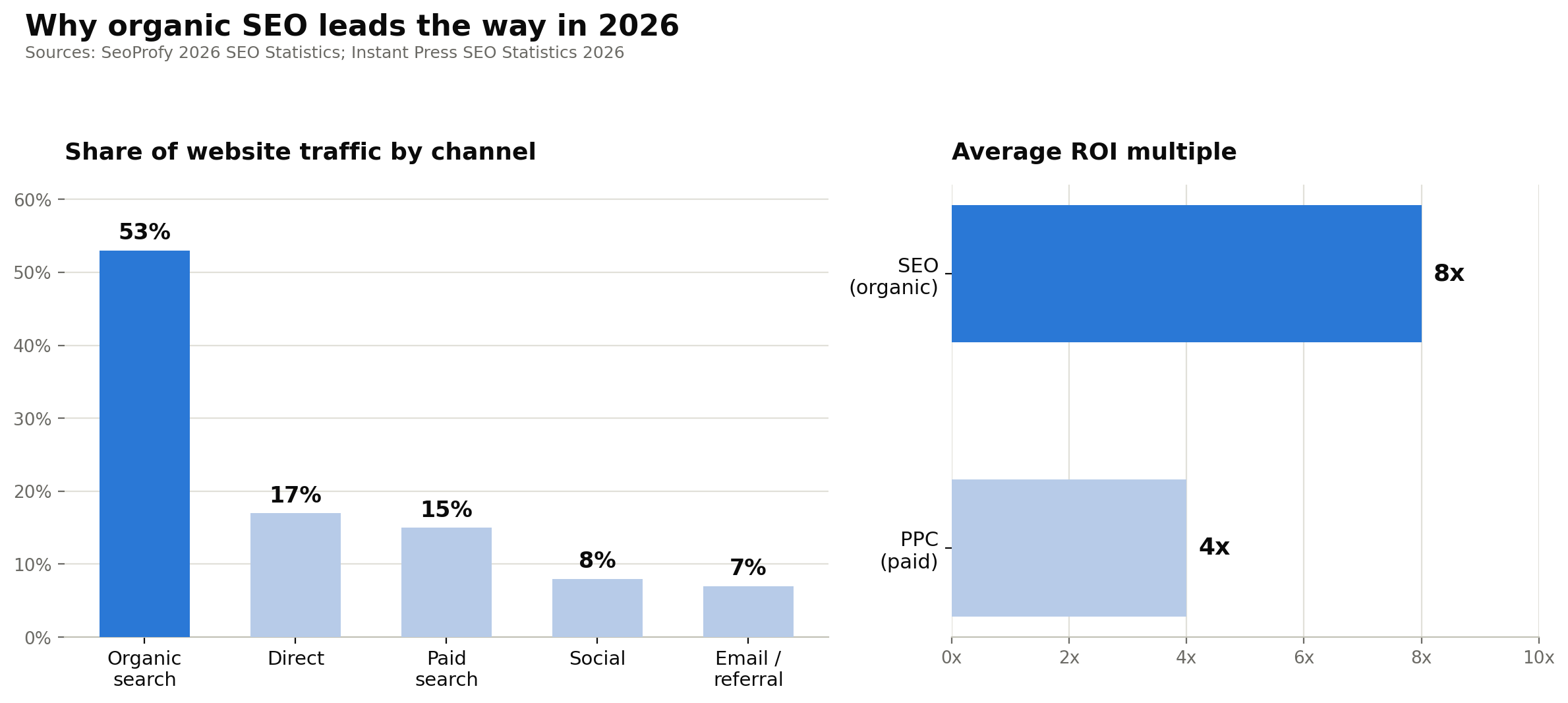
This shows organic search’s share of traffic relative to other channels (53%, more than double the next-closest source), as well as how SEO’s ROI compares with paid search. Sources: Instant Press SEO Statistics 2026
1. More than two-thirds of Google searches now end without a click
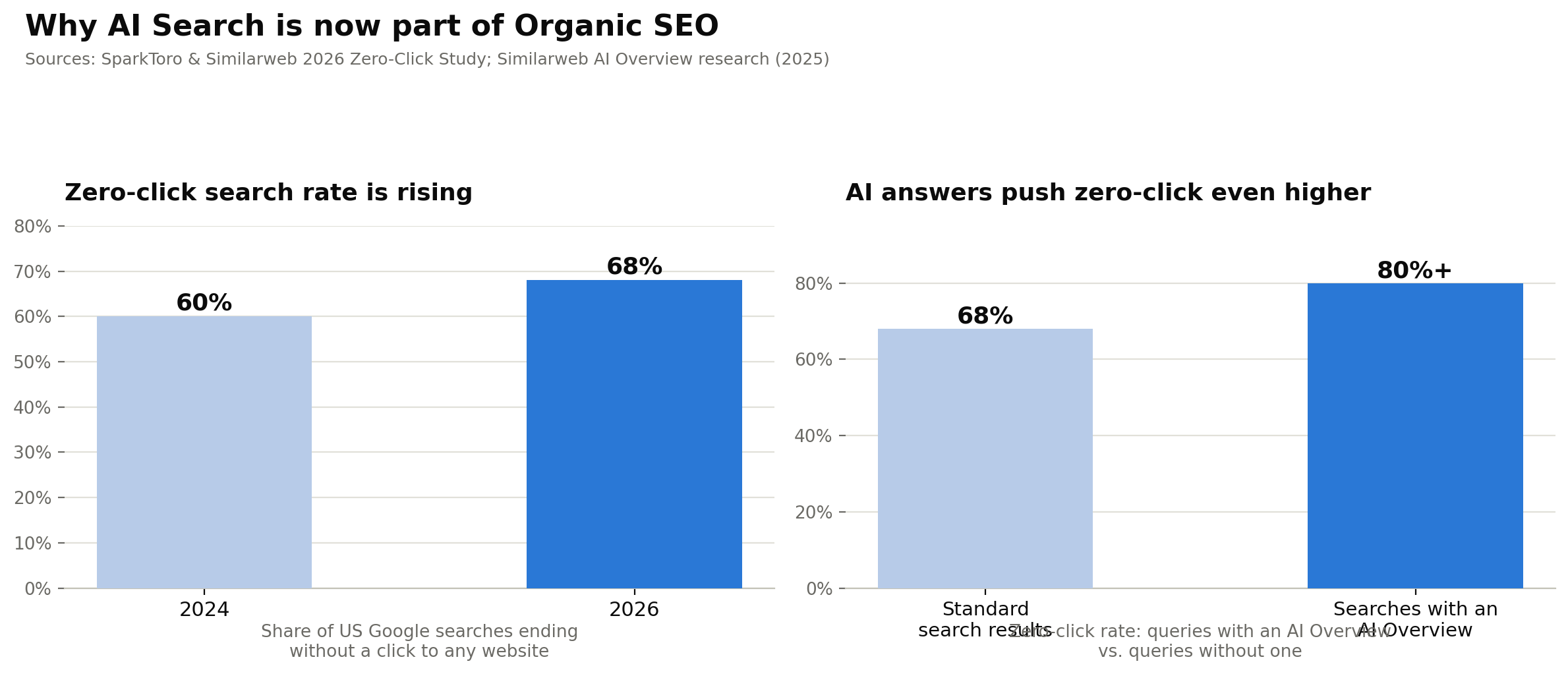
Recent zero-click research from SparkToro and Similarweb found that roughly 68% of U.S. Google searches in early 2026 ended without the user clicking through to any website, up sharply from around 60% just two years earlier. In practice, that means for every 1,000 searches, only a few hundred clicks actually reach a website.
What it means: Ranking well is no longer enough on its own. Your content also has to be structured so it gets pulled into the answer itself, not just linked to below it.
2. AI Overviews push zero-click rates even higher
When a search triggers Google’s AI Overview, zero-click behavior jumps even further into the 80%+ range, according to Similarweb’s 2025 research. The AI-generated summary answers the question directly, and many users never scroll further.
What it means: Being cited inside an AI Overview is quickly becoming as valuable as ranking #1 used to be. AI Search optimization earning visibility inside AI-generated answers isn’t a separate discipline from SEO anymore. It’s becoming a core, non-negotiable part of it.
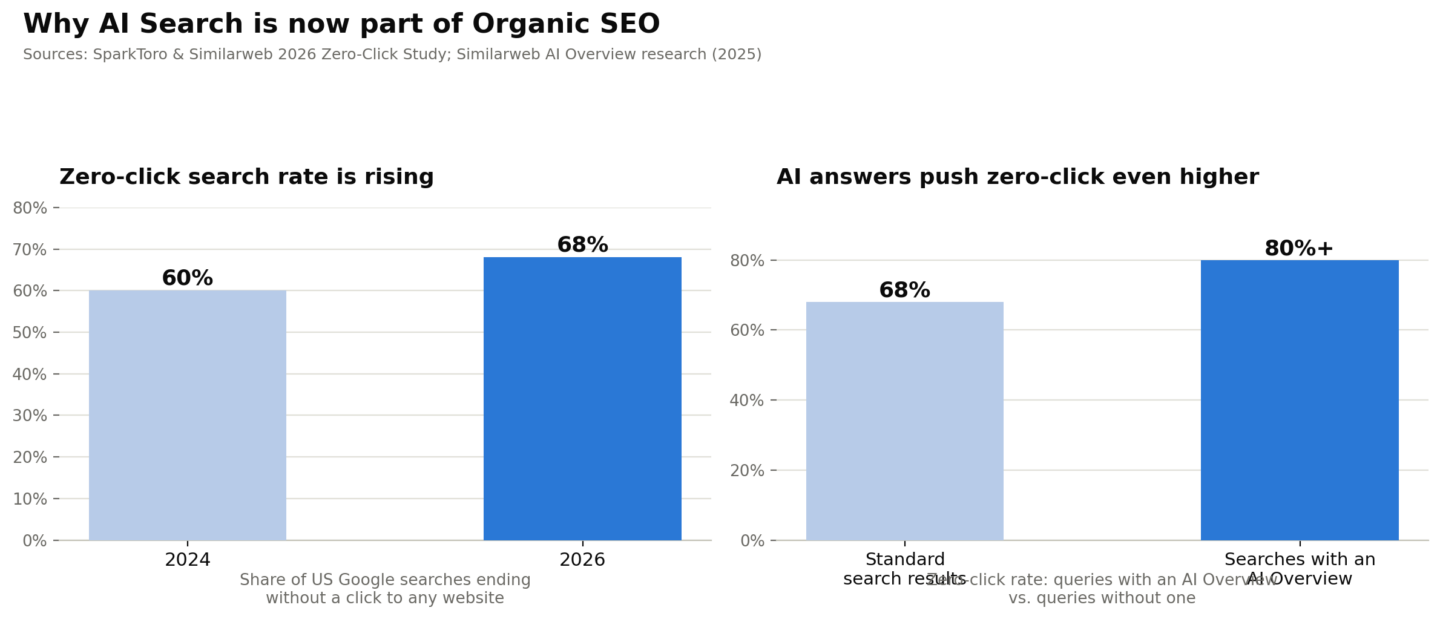
This image shows the zero-click trend accelerating (60% → 68% in two years) and how AI Overviews push that even higher (80%+), which is exactly the data point that makes the case for AI Search being a required part of Organic SEO now, not a separate service. Instant Press SEO Statistics 2026
3. Organic search is still the single largest traffic source for most businesses
Despite all the disruption, organic search still drives roughly 53% of all trackable website traffic across industries more than paid search, social, and email combined in most cases.
What it means: SEO isn’t being replaced; it’s being layered with new surfaces (AI answers, local packs, etc.). Businesses that abandon organic strategy in favor of paid-only approaches are leaving their biggest channel underfunded.
4. Google still controls roughly 9 in 10 searches worldwide
Google holds close to 90% of global search market share in 2026. Bing trails at around 5%, with the rest split among smaller players.
What it means: Google remains the primary system to optimize for but “optimizing for Google” now includes its AI Mode and AI Overviews, not just traditional rankings.
5. SEO delivers roughly double the ROI of paid search
Industry benchmarking puts SEO’s average ROI at around 8x, roughly twice the return typically seen from PPC campaigns, largely because organic traffic keeps compounding long after the initial investment while paid traffic stops the moment spend stops.
What it means: SEO builds more slowly than paid ads, but it’s the more durable asset. The strongest client results we see at Shoreline usually come from running both channels together: SEO for long-term equity, PPC for immediate demand.
6. The #1 organic result still earns nearly 4x the clicks of an average listing
Even with zero-click search on the rise, position still matters enormously among the clicks that do happen: the top organic result captures an average 27.6% click-through rate, and the top three results combined take in roughly 54% of all clicks on the page.
What it means: There’s a real difference between ranking on page one and ranking in the top three and that gap is closed with on-page SEO, site architecture, and content quality, not luck. A well-optimized website is what turns “we rank somewhere” into “we rank where the clicks are.”
7. Nearly half of all Google searches have local intent
Around 46% of Google searches carry local intent: people looking for a nearby business, service, or location. And 76% of people who run a “near me” style search on their phone visit a business within a day.
What it means: For local and multi-location businesses, Google Business Profile optimization and local SEO aren’t optional add-ons; they’re often the highest-converting channel available.
8. Mobile now accounts for the majority of search and retail traffic
Mobile devices drive more than 62% of global web traffic and 77% of retail site visits. Search behavior and buying behavior are happening on phones first.
What it means: Page speed, mobile usability, and clean mobile checkout experiences are ranking and conversion factors at the same time. This is where website quality and SEO stop being separate line items; a slow, dated, or hard-to-navigate site doesn’t just rank worse; it actively loses customers who already found you.
9. Top-ranking pages have nearly 4x more backlinks than lower-ranked pages
Pages that rank at the top of Google search results average 3.8 times more backlinks than pages ranked lower, reinforcing that authority signals still carry significant weight in rankings.
What it means: Content and technical SEO alone rarely get a competitive keyword to page one. Earned links and digital PR remain one of the strongest ranking levers available.
10. Generating traffic and leads is still marketers’ #1 challenge, and SEO is the most-cited solution
61% of B2B marketers name generating traffic and leads as their top marketing challenge, and SEO continues to be identified as the most effective channel for solving it, ahead of paid and social alternatives.
What it means: The businesses winning right now aren’t the ones spending the most; they’re the ones with the most disciplined, sustained SEO strategy addressing the exact problem most companies say they’re struggling with.
The bottom line: Organic SEO isn’t going anywhere, and AI Search is now part of it
Search in 2026 isn’t dying; it’s expanding into two systems businesses have to win at once: traditional rankings and AI-generated answers. That’s not a temporary trend to wait out. It’s the new baseline. Every business moving forward, regardless of industry or size, will need a real Organic SEO strategy one that now includes AI Search optimization as a core component, not an optional add-on.
The data backs this up at every level: organic search still drives more traffic than any other channel, it delivers stronger ROI than paid alternatives, and it’s the channel marketers most consistently point to when asked what actually solves their biggest challenge generating traffic and leads. None of that is fading. What’s changing is where that organic visibility shows up inside classic search results and, increasingly, inside the AI answers replacing them. Businesses that treat SEO as optional, or as something they’ll “get to eventually,” aren’t just falling behind on rankings. They’re opting out of the primary way customers find businesses online, both now and for the foreseeable future.
At Shoreline Digital Marketing, this is exactly where we start with every client: a website built to convert, an Organic SEO strategy built to be found, and AI Search optimization built in from day one, not bolted on later. From there, we layer in PPC and CRM/Marketing Automation to accelerate results, but the foundation always comes first, because it’s the one piece of digital marketing that isn’t going away.
Curious where your website and search visibility currently stand? Reach out to Shoreline Digital Marketing for a free visibility audit.
Sources: Similarweb 2026 Similarweb AI Overview research (2025)